| Rat poison forces beach-goers away – MoH holds ‘extermination’ session, environment safe |
| | Tue, 15 May 2012 |
| |  |
| |
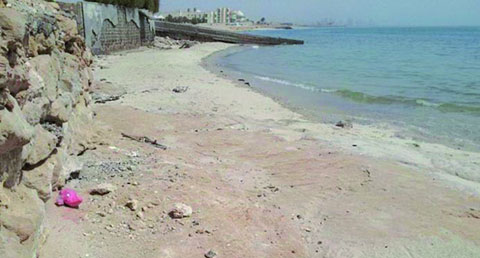
KUWAIT: Rat poison distributed at a stretch along Messila beach has forced expatriates to look for other places to walk, barbecue or meet with friends. Some were worried about having their children play around poison. Others, have also raised concern about the environmental impact of having rat poison distributed in such close proximity to the waterfront. Pictures published at the end of last week by EEK (Expats Express Kuwait), an expatriate e-magazine (www.abcq8.com), showed bags of pink rat poison placed under rocks and in burrows along a stretch along the beach at Messila. The pictures were taken by two expatriate families with children who were visiting their favorite picnic spots.
A Kuwait Times investigation revealed that the operation for the distribution of poison was conducted by official workers from the Medical Insect and Rodent Fighting Department (MIRFD) of the Ministry of Health. The workers distributed the poison along the seaside from Shuwaikh beach to Messila beach last Thursday.
The MIRFD has a two-tier operation system. “If we have receive a complaint from people about an infestation of insects or rats we send a team to go to the place and exterminate these insects or rats,” explains Ibraheem Othman, Head of the MIRFD Complaints Department.
Speaking to the Kuwait Times yesterday, he said that the team of workers also goes on regular inspections across Kuwait throughout the year. “We distribute poison during these inspection sessions according to our work plan, even if there are no rodents or rats. This is done as a prevention,” Othman said.
Asked about the hazard that such a poison distributed in public places could cause to beach-goers, Othman ensured that it only affects rats. “First of all we choose the places that are somehow hidden and far from visitors, especially children,” he said, elaborating that the poison powder only has an effect on rats.
Concerned expatriates queried whether such amounts of poison could have an environmental impact. Their concern was refuted by Othman and a representative of the Environment Public Authority. According to Othman, the poison cannot pollute the sea or affect the marine environment, as it loses its toxic features immediately after coming into contact with water. Dr. Salah Al-Mudhi, General Director of the Environment Public Authority (EPA), said the Ministry of Health is responsible through the MIRFD for exterminating rodents. He explained that the department follows certain regulations and is aware of their work.
“They know the right and safe way to distribute poison in public areas. If people see some suspicious distribution of poison or other materials they should report it either to the MIRFD or the Ministry of Interior to make sure that these people represent the official department. Otherwise, if such an act is done by individuals, it may be harmful for both the environment or to people and they will be responsible for any damage caused,” he pointed out.
(Tel: 24848088 ext. 775)
Othman explained that the next extermination inspection by the department will be a visit to Jleeb Al-Shuyoukh this month to exterminate rodents.
A western expatriate, who has been visiting that spot at Messila for more than 12 years, told the Kuwait Times that he had never seen something like this before. “Sadly (or lucky for me) we moved away from that area about two years ago but still pop in now and again. From Wednesday evenings onward, if you are not there early, there is no chance that you will get a spot to picnic and the benches on the walkway are stuffed with people. It really is a great place,” he said.
|